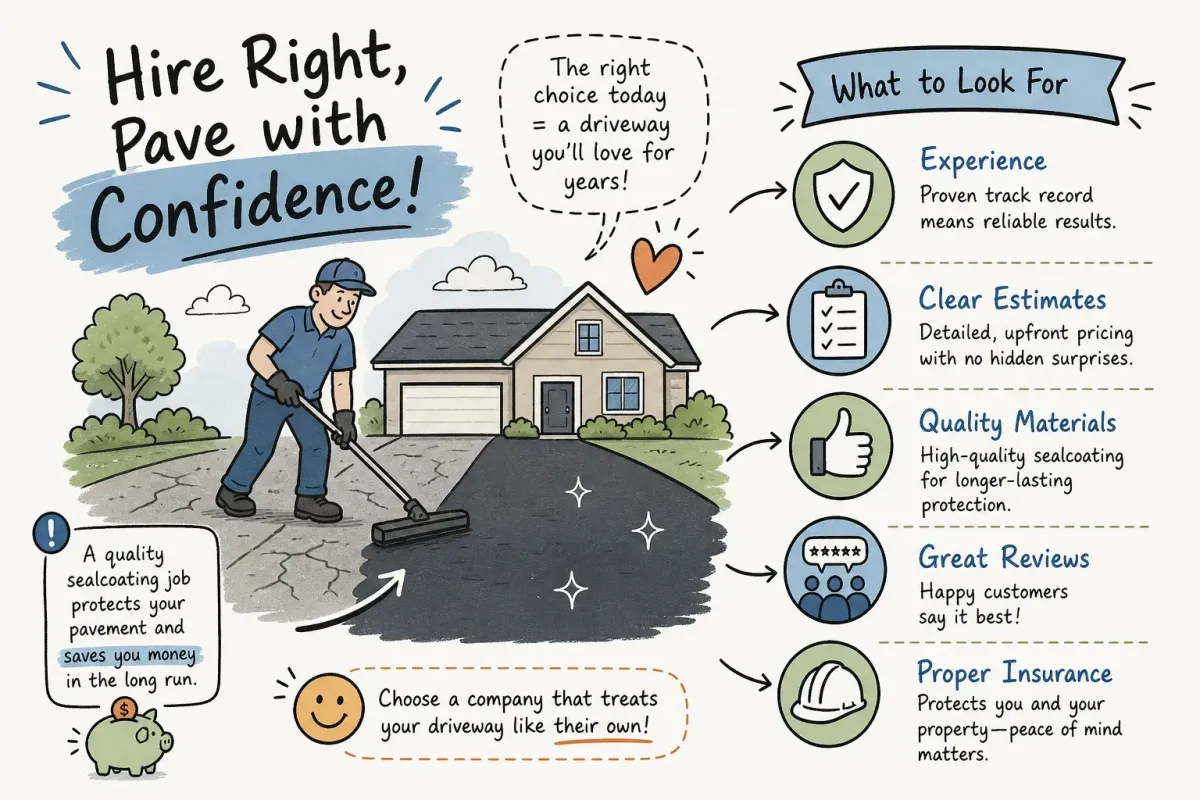
What to Look for When Hiring a Sealcoating Company

What to Look for When Hiring a Sealcoating Company
What should you look for when hiring a sealcoating company? That question matters more than most homeowners realize until something goes wrong. Many pavement failures are caused or accelerated by poor installation or maintenance rather than the original materials. A sealcoat applied incorrectly can peel prematurely, sometimes within a single season, void any protection you thought you were buying, and leave your driveway worse than if you'd skipped it entirely. The lowest price on a flyer is rarely the right price for a job done right.
What you need is a sealcoating contractor who is licensed, locally experienced, and upfront about everything before work starts. First Due Sealcoat & Striping, a firefighter-owned asphalt maintenance company serving Middle Tennessee, operates that way: written estimates, documented insurance, and straight answers on materials and prep. This article gives you the checklist to hold every contractor to that same standard.
Licensing and insurance: the baseline every sealcoating contractor must meet
What to verify before anyone touches your pavement
This is not a step to skim. Some homeowners skip licensing and insurance verification entirely, then find themselves without legal recourse when something goes wrong. Before a contractor touches your pavement, you need documentation, not promises.
There is no single national sealcoating license, but contractors are still required to hold valid state or local registration wherever they work. In Tennessee, asphalt and paving work falls under the state's contractor licensing rules, administered by the Board for Licensing Contractors. The practical threshold is a$25,000 project value, above which a Tennessee contractor license is required before the company can bid or contract for the job. For smaller residential projects, the license requirement may apply differently, but a contractor who can't produce any documentation is still a liability, not a deal.
Insurance minimums to request
On insurance, verify at minimum general liability coverage and workers' compensation if the crew has employees. General liability protects your property from damage caused during the job; workers' comp protects you from a lawsuit if a crew member is injured on your driveway. Coverage limits vary widely by jurisdiction and job type, contractors often carry anywhere from $250,000 to $1,000,000 in general liability. Ask for a certificate of insurance and verify it directly. A verbal confirmation is not documentation.
Some Tennessee counties and municipalities also require a surety bond for licensed contractors, particularly on commercial pavement maintenance work. A bond gives you legal recourse if the contractor walks off the job or fails to deliver. It's worth asking whether your contractor carries one, especially for larger or commercial projects; if you want more background on typicalcontractor insurance and bond requirements, that overview is a helpful starting point.
The right questions to ask before you agree to anything
What to look for when hiring a sealcoating company: experience and materials
Once licensing and insurance are confirmed, pressure-test the contractor's actual experience and approach. These questions separate legitimate asphalt professionals from crews treating sealcoating as a side operation.
Start with local experience. Ask how long the company has operated specifically in Middle Tennessee, not just "in the region." Tennessee's climate puts real stress on asphalt: humid summers, freeze-thaw cycles in winter, and heavy spring rainfall. A contractor with genuine local experience understands when to schedule work and how to prepare surfaces for those specific conditions. Ask for references from jobs completed in your county within the last 12 months, and actually follow up on them.
Ask about materials and application method next.Asphalt emulsion sealer is generally better suited for residential driveways: it's more flexible, lower in odor, and handles temperature swings well. Coal-tar is more chemical-resistant and often used on commercial lots. A professional can explain why they're recommending one over the other for your specific surface. If they can't explain it, they're guessing. Application method also matters: spray application covers larger surfaces faster, squeegee forces material into surface pores and worn areas, and a combined approach is common on professional jobs where surface texture varies. You want a straight answer on what they're doing and why.
Finally, ask what surface prep is included before any sealer goes down.Prep is where cheap contractors cut corners, and where quality work begins. Crack filling, pothole patching, oil-spot primer treatment, edge cleaning, and pressure washing should all be addressed before a drop of sealer is applied. If a contractor doesn't mention prep at all when you ask, that tells you everything you need to know. For a practical checklist of preparatory steps, see this concisesurface preparation guide for asphalt maintenance.
What a complete sealcoating estimate should include
A vague estimate sets up disputes later. A professional sealcoating estimate should be specific enough that you could hand it to a different contractor and have them price it accurately.
For a residential driveway, a complete estimate should list: square footage being sealed, surface cleaning method (sweep, blow, or pressure wash), crack filling scope (linear footage or a stated "as needed" clause with defined limits), oil-spot primer treatment, number of sealer coats, and cure time before vehicle use. If the estimate just says "sealcoat driveway: $350," you have no way to hold the contractor accountable if prep steps are skipped.
On pricing in Middle Tennessee, professional driveway sealcoating generally runs about $0.20 to $0.39 per square foot based on Tennessee residential market data. A standard two-car driveway typically falls in the 400 to 600 square foot range, putting most jobs somewhere between $160 and $235 at those rates before any additional repairs. Crack filling and pothole repairs are usually quoted separately. If a quote comes in significantly below that floor, something is likely being left out, prep steps, a second coat, or an under-specified scope. For current national cost ranges and contractor pricing examples, consult typical driveway sealcoating cost estimates.
When comparing multiple quotes, don't compare bottom-line numbers if the scopes differ. Compare line items. A slightly higher sealcoating estimate that includes proper crack filling, two coats, and oil-spot treatment is almost always a better value than a stripped-down quote that skips all of that.
Sealcoat warranties: what they cover and what they don't
Reputable sealcoating companies offer written warranties, but a lot of homeowners don't read them carefully until there's already a problem. Understanding what a sealcoat warranty actually protects you against is a different question from simply knowing one exists.
Most professional warranties run six months to two years and cover defects in materials and workmanship: premature peeling, flaking, or coating failure caused by bad product or improper application. Some contractors will return for a free repair if a covered issue is reported within the warranty period. That's the protection you're paying for when you choose a sealcoating contractor with a documented guarantee. For examples of the kinds of warranty language contractors commonly use, review typicalpavement warranty examples.
Standard exclusions matter just as much.Most sealcoat warranties don't cover normal wear and oxidation, chemical spills like oil or antifreeze, snowplow or tire chain damage, vegetation intrusion, or failures caused by pre-existing base problems.If your asphalt had underlying structural issues before the sealer went down, those aren't the contractor's liability under most warranty terms. Get the exclusions in writing before work starts, not after you're trying to make a claim.
Red flags that tell you to walk away
These warning signs don't automatically mean a contractor is operating in bad faith. They mean the risk isn't worth taking when reliable alternatives exist, and in Middle Tennessee, they do.
The most common scam in pavement maintenance follows a predictable pattern: a crew shows up unsolicited, claims they have leftover material from a nearby job, and offers a steep discount if you decide today. Consumer protection agencies and industry watchdogs have flagged this tactic repeatedly, particularly in the South, where traveling crews move quickly from area to area before homeowners can check references or verify credentials. Legitimate sealcoating companies book scheduled work. They don't cold-canvass neighborhoods with leftover sealer. If a crew shows up unannounced at your door, pass on it. The EPA has even issued afraud alert on asphalt sealer scamsdescribing these and similar tactics.
Watch for these additional warning signs:
No certificate of insurance or license documentation when asked
Cash-only payment demands, especially upfront before work begins
No written estimate, vague scope of work, or resistance to putting anything in writing
Out-of-state plates, no local address, no verifiable references in your county
Verbal-only warranties with no written terms
A contractor who pushes back on documentation isn't set up to handle a dispute professionally. Your warranty, scope of work, and payment terms all need to be in writing before work starts. If they resist that, the answer is no.
What a qualified Middle Tennessee sealcoating contractor actually looks like
Once you've run a contractor through this checklist, you'll know quickly who meets the standard. First Due Sealcoat & Striping is a firefighter-owned and operated asphalt maintenance company serving Williamson, Davidson, Rutherford, and Maury Counties, including Nashville, Franklin, and Murfreesboro. They offer free estimates, carry proper licensing and insurance, and approach every job with the kind of accountability you'd expect from a company whose owners work alongside the crew.
Their work is built around Tennessee's specific pavement demands. Summer heat requires careful timing to prevent sealer from drying too fast and losing adhesion. Winter freeze-thaw cycles make crack filling a priority before the season turns. That local knowledge is something a national chain's pricing algorithm won't account for. When First Due provides a sealcoating estimate, the process starts with a surface inspection, existing damage is noted, and required prep is explained before any commitment is made.
Free estimates, proper licensing and insurance, and a transparent process from the first call: those aren't extras, they're the baseline, and it's what First Due delivers consistently across Middle Tennessee.
The short version before you make a call
Knowing what to look for when hiring a sealcoating company comes down to one principle: protect yourself before the work starts. Verify licensing and insurance in writing, get an itemized estimate that covers every prep step, understand exactly what the sealcoat warranty covers and excludes, and trust your judgment when a contractor avoids putting anything on paper.
This sealcoat service checklist applies whether you're a homeowner in Franklin getting a driveway sealcoating done or a property manager in Murfreesboro overseeing a commercial lot. Keep in mind that licensing thresholds and permit requirements can shift based on project value and whether the work is residential or commercial, so always confirm the specifics for your job type. When you find a contractor who passes every check without hesitation, you've found the right one.
If you're in Middle Tennessee and want to see what that standard looks like firsthand, First Due Sealcoat & Striping offers free estimates across multiple Tennessee counties. Call them, get the estimate, and you'll have a real benchmark for every contractor after that.