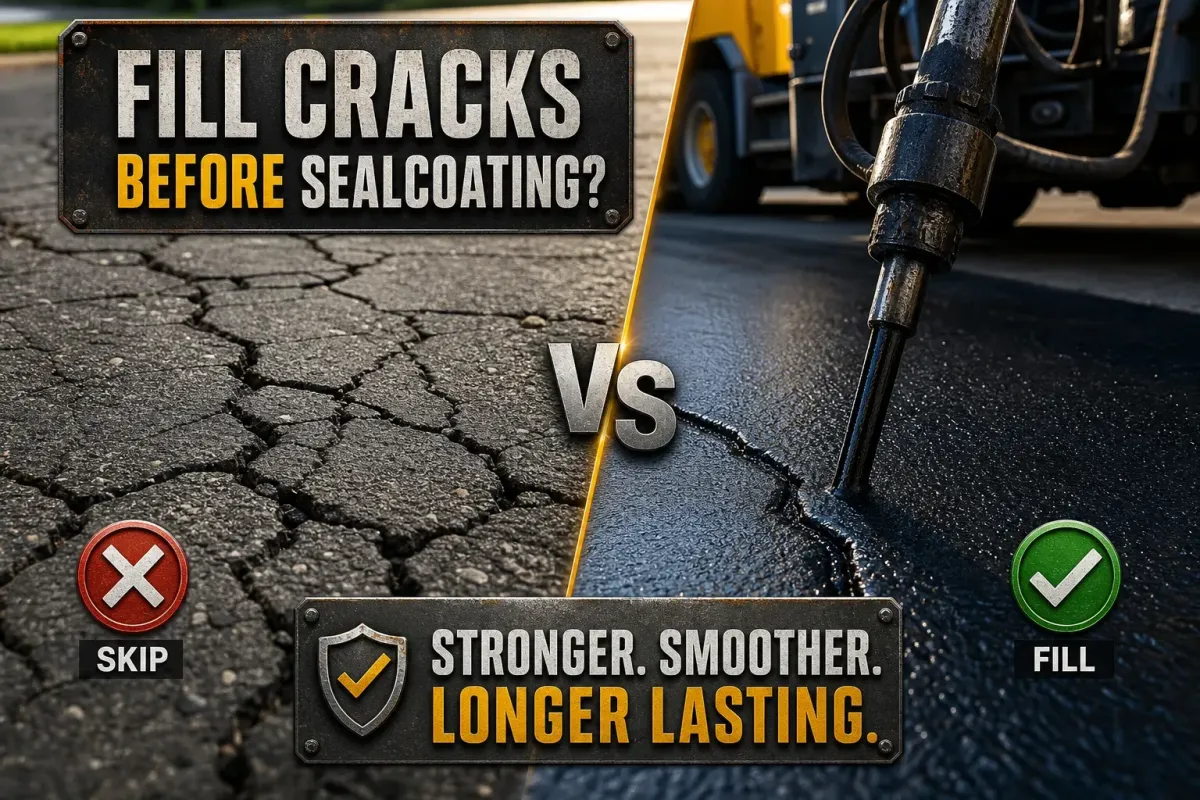
Should You Fill Cracks Before Sealcoating? Here's the Truth

Should You Fill Cracks Before Sealcoating? Here's the Truth
Should I fill cracks before sealcoating my driveway? Yes, and skipping that step is the most common reason sealcoating jobs fail. Poor prep work, not the sealer itself, is typically where the outcome gets decided. Crack filler and sealcoat are separate products that do separate jobs, and the order they go down matters as much as the products themselves.
At First Due Sealcoat & Striping, every sealcoating job in Middle Tennessee starts with a full crack assessment before a single drop of sealer goes down. That's not extra work. It's just the right sequence. Skipping it wastes the sealer, wastes your money, and leaves the underlying damage to keep spreading unchecked.
This guide covers why the sequence matters, which cracks to address first, what materials work for different situations, and how long to wait before sealcoating follows.
Should I Fill Cracks Before Sealcoating My Driveway? Here's Why the Answer Is Yes
Sealcoat is a surface barrier. It protects asphalt from UV damage, oxidation, and surface wear. What it is not designed to do is bridge open voids or stop water from working through a crack into the base. When you apply sealcoat over an unfilled crack, it spans that gap as a thin, unsupported film. That film can fail within months, especially in active freeze-thaw climates like Middle Tennessee's winters.
The real damage driver is water. It enters through open cracks, works its way into the asphalt base layer, and in Tennessee's winter months, it freezes. Water expands by roughly 9% when it turns to ice, and that expansion pushes the crack edges apart from the inside. Each freeze-thaw cycle repeats the process, widening the crack, weakening the base, and eventually turning a surface-level problem into a structural one.
How water turns a small crack into a big repair bill
Picture a Middle Tennessee driveway after a wet November. Water seeps into a half-inch crack, temperatures drop overnight, the water freezes, and the crack edges shift slightly. The ice thaws the next afternoon and the crack is now wider. More water enters with the next rain, reaches deeper into the base, and the cycle restarts. By spring, what started as a crack you could fix for a few dollars has turned into crumbling asphalt edges and a softened base that needs patching or full replacement.
A sealcoat applied over that crack doesn't interrupt this cycle at all. It covers the entry point temporarily while the damage continues underneath. The only way to actually stop it is to fill the crack first, before the sealer goes down.
Why sealcoat isn't designed to fill cracks
Sealcoat is an emulsion-based coating. Its job is to restore the surface, block UV rays, slow oxidation, and protect the top layer of aggregate from traffic wear. It applies thin and cures into a hard protective film. Crack filler, by contrast, is formulated to fill voids, bond to crack walls, and either flex with pavement movement or hold a rigid seal in stable cracks. Using sealcoat to do crack filler's job is like patching a hole with paint. The products look similar in a bucket, but their purposes don't overlap.
Which cracks need filling and which ones signal bigger trouble
Crack width and pattern tell you exactly what you're dealing with and what the right response is. Most cracks between hairline and one inch wide are candidates for filling before sealcoating. Anything wider than one inch functions more like a pothole and needs to be treated as one. The more critical distinction, though, is pattern, because a clean linear crack and alligator cracking are not the same problem at all. For a clear comparison on treatment approaches, see a professional comparison of crack sealing vs. crack filling.
Reading crack width to choose the right treatment
Matching the repair method to the crack size is straightforward once you have a reference point. Here's how crack width maps to the right treatment during driveway sealcoat prep:
Hairline to 1/4 inch crack width: Fill with pourable crack filler
1/4 inch to 1/2 inch crack width: Fill with hot rubberized crack filler
1/2 inch to 1 inch crack width: Fill with hot rubberized crack filler or asphalt patch if structural concern
Over 1 inch crack width: Treat as a pothole, not a crack and fill with cold asphalt patch
The goal is simple: match the product to the problem. A cold pour filler in a working three-quarter-inch crack will fail quickly because the material isn't elastic enough to handle pavement movement. Getting this match right is what separates a repair that holds from one that needs redoing before the next winter.
When alligator cracking means you stop and call someone
Alligator cracking looks like a series of interconnected cracks forming a pattern resembling reptile scales. It's not a surface problem. It indicates base failure, meaning the foundation layer beneath the asphalt has weakened to the point where the surface above it is crumbling under load. Neither crack filling nor sealcoating addresses this.
Sealcoating over alligator cracking is a cosmetic patch over a structural problem, and it will look rough again within months. This type of damage needs professional assessment and likely full-depth asphalt patching before any surface treatment makes sense.
Choosing the right crack filler: cold pour vs. hot pour crack filler
Material selection comes down to matching the product to the crack size and how much movement that crack experiences. There are two main options for driveway sealcoat prep: cold pour and hot pour rubberized filler. Cold pour works well for smaller, stable cracks and is the easier DIY option. Hot pour rubberized filler is the professional standard for active cracks because it's formulated to flex as pavement expands and contracts through temperature swings. Get this choice wrong and the repair fails before the sealcoat is even scheduled.
Cold pour vs. hot pour crack filler: what each is actually for
Cold pour fillers are acrylic or latex-based, come in cartridges or pour bottles, and apply with a caulk gun or pour spout. They're economical and straightforward to use, but they cure into a relatively rigid material. That makes them a solid choice for hairline to quarter-inch cracks that aren't experiencing much seasonal movement. Hot pour rubberized filler is a different product entirely. It's heated to application temperature, flows into the crack, bonds to the walls, and cures into an elastic material that moves with the pavement through temperature cycles. For working cracks, hot pour lasts significantly longer and is the professional standard for a reason. For detailed industry guidance on proper sealing techniques, consult established crack sealing best practices.
Step-by-step prep matters too, if you're tackling a DIY crack repair, resources onpreparing a crack for filling walk through cleaning, routing, and the surface prep that make a filler stick and last.
When asphalt patching replaces crack filling
For deep cracks in the half-inch to one-inch range, use a backer rod before applying filler. A foam backer rod inserted into the crack reduces depth before filler is applied, which keeps the filler from sinking and ensures proper bonding near the surface. For anything crossing into pothole territory, a cold patch product is the right tool, it provides the structural support that crack filler cannot. The test is practical: if the void is deep enough to require multiple applications of filler just to reach surface level, it needs patching, not sealing.
Should I fill cracks before sealcoating my driveway? Timing and conditions matter too
Getting the material right is only half of the job. Applying sealcoat before crack filler has fully cured guarantees adhesion problems. The sealcoat traps moisture in the uncured filler, prevents a proper cure beneath the surface, and the bond between the two products never sets correctly. Patience here isn't optional, it's part of the job.
Minimum cure times for cold pour and hot pour fillers
Cold pour filler needs a minimum of one week before sealcoat goes over it. Hot pour rubberized products often require longer cure windows. Many manufacturers specify a minimum of two weeks, with some products requiring up to 60 days depending on conditions, check the specific product guidelines before scheduling your sealcoat. That longer window exists because rubberized material continues to stabilize and settle after it cools.Rushing sealcoat over incompletely cured hot pour filler is a reliable way to waste both products and redo the job sooner than you planned.For general guidance on drying and curing of surface treatments, manufacturers' resources such as how long asphalt sealer takes to dry are useful references to set realistic timelines.
Temperature and humidity requirements for both steps
Temperature thresholds differ slightly between the two steps. Crack filler can generally be applied when pavement temperatures are at or above 40°F, though specific products vary, always check the manufacturer's specs. Sealcoating requires both air and pavement temperatures of at least 50°F for proper adhesion and curing. For both steps, humidity should be below 60%, the pavement surface must be completely dry, and no rain should be in the forecast for at least 24 to 48 hours before or after application. In Middle Tennessee, spring and fall offer good windows for this work, but conditions can flip quickly in either season. A dry, mild morning can give way to afternoon thunderstorms. Check the forecast for a full 48-hour window, not just the morning of the job.
What it costs and when to stop doing it yourself
Crack repair before sealcoating is not a major expense on its own, but skipping it leads to sealcoat failure, repeated applications, and eventually more costly structural repairs. Knowing rough numbers helps set expectations and makes the call between DIY and hiring a professional much clearer.
Typical cost ranges for crack repair and sealcoating
Professional crack repair runs roughly $3 to $17 per linear foot depending on crack size, depth, and repair method. Sealcoating runs approximately $1 to $3 per square foot for most residential driveways, though regional pricing varies. Both figures scale with the extent of the damage, a driveway with a few clean linear cracks costs much less to prepare than one with widespread deterioration. These are ballpark numbers. The only way to get an accurate figure for your specific driveway is a site assessment before any work is quoted or committed.
Signs the job is past DIY territory
Some conditions clearly signal that professional involvement makes more sense than a weekend project. Watch for these:
Alligator cracking anywhere on the surface
Cracks covering a large portion of the driveway area, widespread cracking affecting more than roughly a quarter of the surface is a strong indicator
Any crack with significant edge deterioration or crumbling along the edges
Cracking patterns that suggest the base is moving or settling unevenly
In these situations, the wrong repair wastes money while the underlying problem keeps progressing. A thorough crack assessment, the kind First Due Sealcoat & Striping performs before every sealcoating job across Middle Tennessee, catches these issues before any product gets applied to the wrong problem. If you need direction on selecting a contractor or what to ask, read What to Look for When Hiring a Sealcoating Company to help vet bids and scope of work.
The bottom line on sequence
If you're still asking yourself, "Should I fill cracks before sealcoating my driveway?", the answer is always yes. Sealcoating over open cracks is wasted sealer. The right sequence protects both the investment and the pavement underneath: assess crack width and pattern, choose the right filler (cold pour crack filler for small stable cracks, hot pour crack filler for active working cracks), wait for full cure, then sealcoat under the right conditions. Skip any step and the job is compromised before it's finished.
If you're in Middle Tennessee and want a professional eye on your driveway before committing to a sealcoating job, First Due Sealcoat & Striping offers free estimates across Davidson, Williamson, Rutherford, and Maury Counties. We'll tell you exactly what the driveway needs, what it doesn't, and the right order to do it in. No guesswork, no upsell. Just the right work done in the right sequence. Learn more about our Crack Filling Spring Hill, TN | First Due Sealcoat & Striping services and schedule an assessment.
For ongoing tips, how-tos, and pavement care advice, check out our Blog | Sealcoating & Pavement Tips, First Due Sealcoat & Striping.